
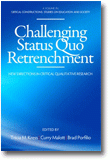
Challenging Status Quo Retrenchment
New Directions in Critical Research
Edited by:
Tricia M. Kress, The University of Massachusetts Boston
Curry Malott, West Chester University of Pennsylvania
Brad J. Porfilio, Lewis University in Romeoville, IL
A volume in the series: Critical Constructions: Studies on Education and Society. Editor(s): Brad J. Porfilio, California State University, Stanislaus. Marc Pruyn, Monash University. Derek R. Ford, DePauw University.
Published 2013
This year (2012) marks ten years of No Child Left Behind and the U.S. federal government’s official designation of what qualifies as “scientifically based research” (SBR) in education. Combined, these two policies have resulted in a narrowing of education via standardization and high stakes testing (Au, 2007) as well as the curtailment of forms of inquiry that are deemed legitimate for examining education (Wright, 2006). While there has been much debate about the benefits and limitations of the NCLB legislation (e.g., Au, 2010) and SBR (e.g., Eisenhart & Towne, 2003), critical researchers have held strong to their position: The reductionistic narrowing of education curricula and educational research cannot solve the present and historical inequities in society and education (Shields, 2012). Contrarily, reductionism (via standardization and/or methodological prescription) exacerbates the challenges we face because it effectively erases the epistemological, ontological, and axiological diversity necessary for disrupting hegemonic social structures that lie at the root of human suffering (Kincheloe, 2004). Not only has NCLB proven incapable of overcoming inequalities, but there seems to be sufficient evidence to suggest it was never really intended to eliminate poverty and human suffering. That is, it seems NCLB, despite its lofty title and public discourse, is actually designed to advance the agenda of handing public education over to for-profit corporations to manage and privatize thereby intensifying the capitalist class’ war on those who rely on a wage to survive (Malott, 2010). In the present ethos, reductionism upholds and retrenches the status quo (i.e. the basic structures of power), and it puts at risk education and educational research as means of working toward social justice (Biesta, 2007). Because social justice can be interpreted in multiple ways, we might note that we understand critical social justice as oriented toward action and social change. Thus, critical education and research may have potential to contribute to a number of social justice imperatives, such as: redistributing land from the neo-colonizing settler-state to Indigenous peoples, halting exploitative labor relations and hazardous working conditions for wage-earners, and engaging in reparations with formerly enslaved communities.
CONTENTS
Introduction: Seizing the “Moment”: Critical Researchers Challenging Status Quo Retrenchment, Tricia M. Kress, Curry Malott, and Brad Porfilio. PART I: (RE)THEORIZING EPISTEMOLOGY, AUTHORITY, ETHICS, AND PURPOSE IN CRITICAL RESEARCH. Uncollapsing Ethics: Racialized Sciencism, Settler Coloniality, and an Ethical Framework of Decolonial Participatory Action Research, Eve Tuck and Monique Guishard. Challenging Epistemological Authority in Qualitative Research: An Emancipatory Approach, Noah De Lissovoy, Emmet Campos, and Jeannette Alarcon. On Considering Quantitative Research, Faith Agostinone-Wilson. Song of Myself: Honoring the Individual as Critical Scholarship, P. L. Thomas. Letters as Windows Into a Life of Praxis: Using the Epistolary Genre to Explore the Tensions Between the Private Self and Public Action, Robert Lake. PART II: CRITICAL RESEARCH WITH/IN EDUCATIONAL SETTINGS AND COMMUNITIES. Flexible, Reciprocal, and On-Site Research: Developing Praxis That Productively Challenges All Participants in a U.S. Urban School Community, Patricia Paugh, Jorgeline Abbate-Vaughn, and Geoff Rose. Multivoiced Research With Children: Exploring Methodological Issues in Children’s Documentation of School Projects, Christina Siry and Carola Mick. “Talk to Students About What’s Really Going On”: Researching the Experiences of Marginalized Youth, Carl E. James and Leanne Taylor. The Politics of Nativism in U.S. Public Education: Critical Race Theory and Burundian Children With Refugee Status, Nick Mariner, Allison Anders and Jessica Lester. Video of the Oppressed: Insights Into Local Knowledge, Perspectives, and Interests With Youth, Donna DeGennaro and Rick Duque. Qualitative Research for Antiracism: A Feminist Approach Informed by Marxism, Sarah Bell and Mike Cole. About the Contributors.
-
Paperback9781623960490
Web price: $45.04 (Reg. 52.99)
-
Hardcover9781623960506
Web price: $80.74 (Reg. 94.99)
- eBook9781623960513


-
 DIY Punk as Education
From Mis‐education to Educative Healing
DIY Punk as Education
From Mis‐education to Educative Healing
-
 Imagining Education
Beyond the Logic Of Global Neoliberal Capitalism
Imagining Education
Beyond the Logic Of Global Neoliberal Capitalism
-
 Multiculturalism, Dialectical Thought, and Social Justice Pedagogy
A Study from the Borderlands
Multiculturalism, Dialectical Thought, and Social Justice Pedagogy
A Study from the Borderlands
-
 Read Aloud Handbook for Native American Children
-
 Rethinking Social Studies
Critical Pedagogy in Pursuit of Dangerous Citizenship
Rethinking Social Studies
Critical Pedagogy in Pursuit of Dangerous Citizenship
-
 The 2017 Hampton Reader
Selected Essays from a Working-class Think Tank
The 2017 Hampton Reader
Selected Essays from a Working-class Think Tank
-
 The Luso-Anarchist Reader
The Origins of Anarchism in Portugal and Brazil
The Luso-Anarchist Reader
The Origins of Anarchism in Portugal and Brazil